Thursday, 13 February 2014

{~eValuation~}

The night of the performance had finally arrived. After what seemed to be an empty piece of theatre a mere few weeks before the show, it seemed we now had something. Nevertheless, this did not hide the fact the show lacked diversity. Even though the show for what it was consisted of some interesting and visually stimulating pieces of physical theatre, I feel we could have explored some of the untouched aspects of the First World War; for instance, the rise of female employment in the staple industries. However, instead the show portrayed heartbroken housewives; a very clouded depiction of the female war effort. As a result, due to the journey within the story line I believe my focus slightly strayed away.
Nevertheless, my commitment still remained as I wanted to make the most of what was available. For example, I believe the bar scene had a lot to offer in terms visual effectiveness. There was a constant tempo in the scene which allowed the transitions to be smooth which heightened the efficacy of the piece. 
On the whole, the piece had a watchable story line that exhibited some well structured physical theatre. As an ensemble we worked very well as the trust between each performer was of the highest quality which is imperative to a performance.  

Katin-Chaplin's-Silky-Moves


The comedic exaggerated  movement Chaplin demonstrates in this short scene provided me with an incentive to devise my 'conscription' piece with Crystal using similar comical movement thus to create an explicit piece of physical theatre seeing as the segment required pure movement and no dialogue.  Even though this scene represents a completely different aspect of the war, the movement conveyed can be presented in a variety of circumstances.  

効率


Monday, 14 October 2013

{The Shakes}

In this exercise we explored the life of a soldier. Firstly, we were told to stand in neutral with our eyes closed and then create the mindset of an everyday British citizen before the war began in 1914.We were then asked to convey this persons everyday lifestyle through mime. I took on the role of an artist who is seen by the public as the town idiot due to his rather bizarre mannerisms.

Eventually, Jack the narrator of our lives stated that the war had become and that conscription had begun.  Everyone in the room began to enroll themselves into the army. The exercise no longer revolved around miming so our characters were allowed to interact with each other thus to show the enthusiasm or pessimism towards the war.

Suddenly, it was the final night before we were shipped off to 6-weeks of training. This stage of celebration naturally took place in a pub. Roars of anger towards the enemy was expressed whilst others who weren't as enthusiastic towards the war stood in the corner downing their last ales and by the end of the night every man was drunk stupid.

The next day Jack narrated as the hangover of all hangovers whilst additionally being the day of saying goodbyes to loved ones etc. Later we were on the ship that took us to the training camp, headaches, nerves and excitement lingered within each of the trainees. When we reached the training camp we began shooting exercises with the traditional English Bayonet. We would aim at our targets and shoot. Next, we would stand in our war stance and run at the enemy screaming war cries; this pumped us up for the war.

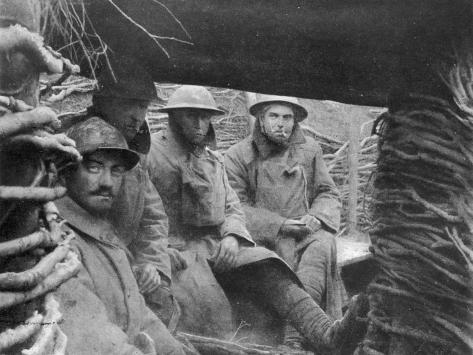
We then began marching to the trenches through mud and water, dirt and gas. At last we reached the trenches, Jacks words clearly portrayed a dead mans land  which was now our home for god knows how long. We imagined the tall daunting trench walls covered with rusty barred wire.

The first night enlightened us of the horrors of war. The deafening sounds of bomb explosions and cries for help was maddening. My character however kept composed aiding those who succumbed to the dreaded 'shakes'. Finally everyone in the class was called by Jack to over the top into 'No Mans Land'. Fear and anger took over the soldiers; some broke down and some stood there emotionless. Jack then shouted 'CHARGE!' and we began to run towards the enemy screaming our war cries. My character just ran singing, shooting into the smoke. Jack would tap on people shoulders signalling that they had been shot; my shoulder was never touched.

At long last the war had ended. We were brought home still affected by the war; characters who portrayed themselves as normal citizens before the war now returned maddened by what they had experienced in the trenches. Jack then told us to stand in neutral and slowly break out of character and reflect on what we had just gone through.

In hindsight, this was one of the most enjoyable exercises I have ever participated in a physical theater lesson for the reason that it allowed me to explore the mindset of a person without just purely focusing of the movement which in my view can emotionally disconnect you from your character. Moreover, the process of this exercise gave me loads of stimulus and ideas for my solo as it allowed me to open up my mind and unconsciously just live the character.


A Little Fillem

Sparky Spark get Shot in the Dark

In our first physical theatre lesson of year 13 we began by studying the flame from a matchstick; how it moved, the colour shades it possessed, the burning life etc. We were then explained to by Jack that during World War 1, sparking a match in the trenches could have been a fatal as one could be sniped down if the light if the match was seen by the enemy. He then told us that these small acknowledgements that had to be used in the war we should bring to our pieces in order to maximize its potential. 

Next, we were instructed to make a trio with the objective to physically express fire with an ensemble movement. I was partnered with Molly and Bradley and we discussed the important role of movement in a flame, as it is unpredictable. As a result, we then stood in a long row of three- Molly sat at the front replicating the top of the lame which moves the quickest, Bradley stood in the middle and mirrored the core of the flame which is most present whilst I stood a the back and took on the role of the bottom of the flame which moves the slowest but has the most fluidity in its movement.


In conclusion, I believe the strengths of this exercise are that it allows you to engage with the smallest details when creating an ensemble or even a solo piece which is an essential factor when attempting to create a successful and effective performance. 

£MIDEA£

After watching a play called 'Not about heroes', a two man play about the relationship between Siegfried Sassoon and Wilfred Owen, I was enlightened to use one of these to poets as my stimulus for my physical solo. As poets their writing styles used rich and vivid literature that portrays a clear picture of the horrors of World War 1. However, I had a particular area which I wanted to explore at that was the life of a soldier. Therefore, I began looking at some of the wartime poems written by Sassoon and Owen. It didn't take me long to find the perfect poem entitled, 'The troops', which uses a variety of adjectives to increase the brutality and horror within the text. The poem explores how a soldiers life in the trenches replicates a  sort of living hell and who slowly are sucked into the war to the point where there is no return and they merely become 'dust'.

Using this poem I came up with the idea of following the step-by-step process of a soldiers life before and during the war. I pictured an artist who lives a quite life in the English countryside who eagerly enlists himself into the British Army when the war begins. During his training he slowly becomes a product of the British army thus losing his identity as an artist; he and the war are one now. Finally, when he is introduced to the life in the trenches he becomes mentally and physically lost. He has reached the point of no return and slowly becomes the monster that is war.